News
Assessment of two years of inventory of mammals in the Fazao-Malfakassa National Park by trap cameras
On Tuesday, August 30, 2022, the Ecology and Ecotoxicology Laboratory of the University of Lomé LAEE and the NGO AGBO-ZEGUE organized an information sharing session on the result of the inventory of mammals in the Fazao-Malfakassa National Park by camera traps at the WASCAL Research Center located at the University of Lomé.
Marking the end of the inventory project, this activity, which took place in the presence of university authorities, such as the director of research at the University of Lomé and the director of the Ecology and Ecotoxicology Laboratory at the University of Lomé, saw the effective participation of financial partners, such as PALCC, represented by the coordinator, represented by the coordinator, a representative of the FAO; a representative of the National Assembly; and representatives of the Ministry of Environment and Resources. Foresters, of Ministry of Tourism, a representative of eco-life, professors, researchers and master students at LaEE and others.
Having started at 9 am, the activity had three main moments:
1- An opening ceremony chaired by Dr. Gabriel Hoinsoude SEGNIAGBETO, 2- A communication on the results of the inventory given by Dr. Gabriel Hoinsoude SEGNIAGBETO 3.and a question-answer and debate session.
After welcoming the various guests warmly, Dr. Gabriel Hoinsoude SEGNIAGBETO, after welcoming the various guests, set the context in which this inventory activity is located and gave the floor to the director of research for his words of circumstance. As for the research director, after welcoming the initiative and emphasizing the importance of popularizing the results of research work and, in addition, the need for universities to be involved in solving the social problems of communities, then articulated his speech around three points, namely: trust, interest and popularization. With regard to interest, he thanked the partners who trusted on the one hand the LaEE laboratory and on the other hand in the NGO AGBO-ZEGUE for agreeing to fund this inventory despite the current global situation hit by the coronavirus pandemic and the scarcity of Ukraine. Then, he highlighted the interest of the study in two parts: first the scientific interest due to the great wealth of the literature review on the one hand and on the other hand the magnificent results of the inventory, followed by societal interest in the context where the present study revives the problem of biodiversity conservation and the need to protect wildlife species and provides a solid weapon for decision-makers to decide on the protection of the National Park through the taking of rigorous decisions. Finally, he dwelt on the importance of popularization, of sharing the results of the inventory, especially at the level of local populations, in order to involve them in conservation and thus avoid the erosion of the Park's wildlife resources.
The Opening Ceremony ended at 9:05am followed by the taking of a family photo.
From 9:55 to 11:30am, Dr. Gabriel Hoinsoude SEGNIAGBETO, after presenting the LaEE Laboratory and the NGO AGBO-ZEGUE, communicated extensively on the results of the inventory. From his presentation, we can remember:
- 100 trap cameras were used to carry out the study and provided a total of 61,089 photos which were then analyzed.
- A total of 09 sampling areas were explored, namely: Cabin, Kalaré, Kamassè, Point of View, Sourkou, Telou-Kagbala, Bounako, Koui and Elavagnon.
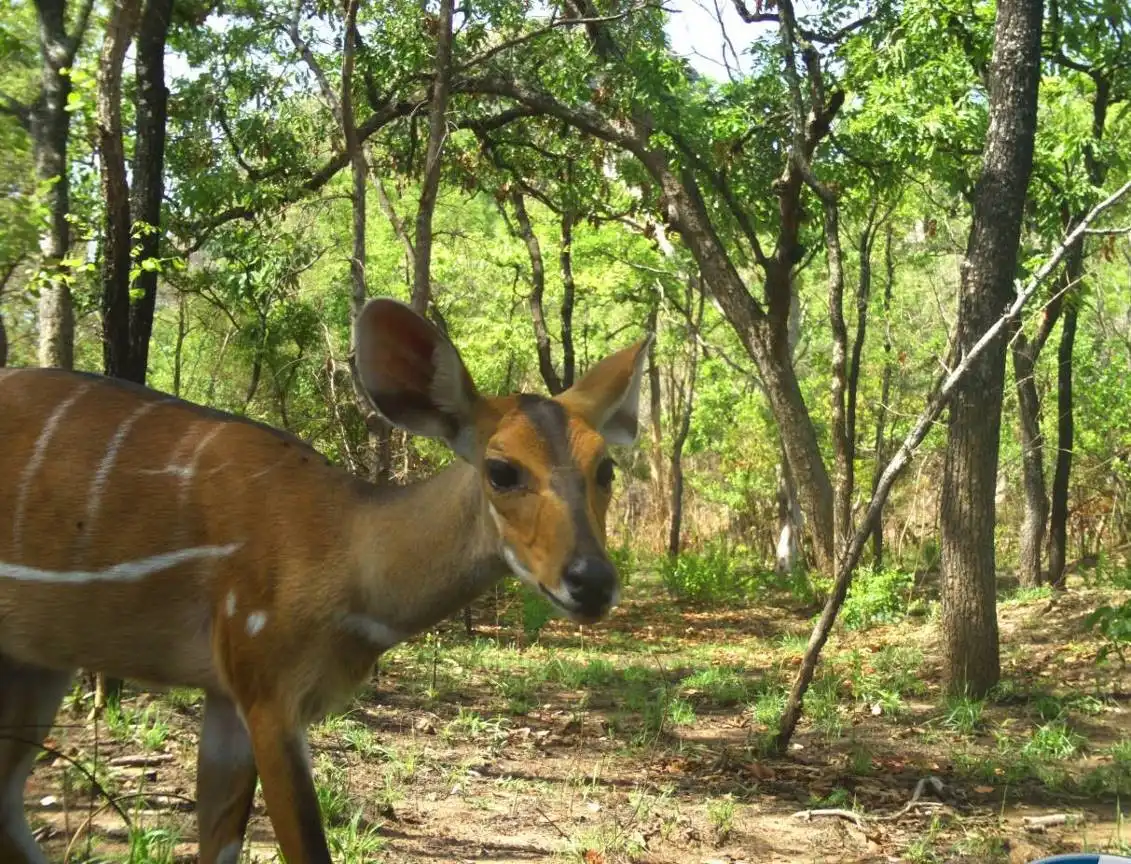
- In terms of maintaining the diversity of mammals, the study reveals a total of 1,564 individuals belonging to 25 different mammal species in the park. These are the following species:
- Elephants (the savannah subspecies and the forest subspecies);
- Ungulates (the most diverse group in Fazao-Malfakassa National Park) represented by 11 species, namely: the Bubale, the Hippotrague, the buffalo, the Cobe Defassa, the Cob of Buffon, the Cob of Buffon, the Harnached Guib, the Harnessed Guib, the Grimm's Cephalophus, the Grimm's Cephalophus, the Grimm's Cephalophus, the Rufous-sided Cephalophus, the Walter's Cephalophus, the Warthog, the Potamogera, and the Aardvark);
- The primates (the baboins, the mona and the vervet);
- Carnivores (four species have been recorded, these are the jackal, the civet, the genet and Crossarchus obscurus);
- Small mammals (pangolins, etc...).
- Hunting is very important in the park and can have a significant impact on the populations of the various mammal species in the park. It must be evaluated, organized and valued for better conservation of animal species in this protected area.
To end the workshop a question and answer session and debate was opened. It should be noted that the importance and interest of the participants were expressed through the free flow of both question and answer sessions and the contributions, suggestions and recommendations of each other for the protection of wildlife resources in this park. This enriched the knowledge of the participants, strengthened their intellectual and professional background, and further motivated the desire to serve their country in conservation. The satisfaction of the participants was fully legible on the faces. The session ended at 1.30 pm.