News
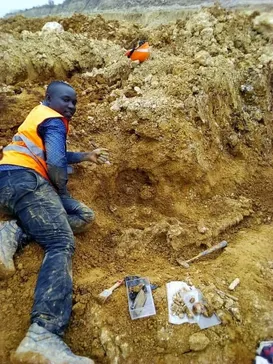
Fossils dating back several million years discovered in Tabligbo (Togo)
It is one of those paleontological discoveries that are only taught at school. This has the merit of being not only the transition from the theory learned on the benches and in the auditoriums to practice on site, but also a feat of the first Togolese doctor in palaeontology. In his thirties, Lucien Amoudji became interested in fossils from the SCANTOGO quarry. What is still presented as a documentary film, is in fact an entry into the story of this young person whose research, lasting two years, is entirely financed by the HeidelbergCement Group in Togo. The discoveries are exceptional!
It is in Sika-Kondji (Tabligbo, Yoto prefecture), more precisely in the career of SCANTOGO, that a mission of paleontological researchers in search of fossils takes place. Among them, Togo's first doctor of palaeontology, Lucien Amoudji, a student at the University of Lomé. For days, under the sun as well as the rain, they have been prospecting and exploring endangered animal species.
The story goes that in 1910, the German paleontologist Stromer identified some fossils in the Tokpli area. A century later, 100 years later, Dr. Lucien Amoudji, helped by a team of paleontologists from the Institut des Sciences de l'Evolution de Montpellier (University of Montpellier/France), set course for Sika-Kondji, in the career of SCANTOGO. The objective of the project is to conduct geology and study the origin and evolution of fossil vertebrates from the end of the Cretaceous period 66 million years ago to the beginning of the Eocene period (56 million years ago). “We did not hesitate for a single minute to support this project, which we find very important for Togo, its heritage, and science. First of all, he is a young Togolese academic whose project on fossil searches in our career seduced us. As the research progresses, we are discovering impressive things,” says Eric Goulignac, CEO of SCANTOGO.
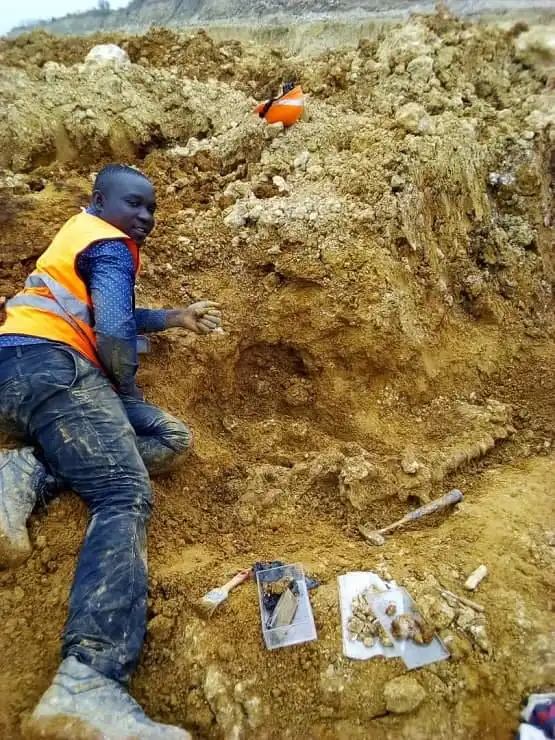
In the field, the exploration phase for fossils in the Sika-Kondji quarry takes place every day. Under a blazing sun, Dr. Lucien Amoudji and his team transport us to fossils identified in their prospective approach. A fascinating, very interesting journey, with muddy crossings, holes to dig deep in search of any clue, etc. “My job is to help them in the field to clear the specimens, to take them and then to prepare them more finely with all the necessary preparation materials. Here, it comes off very well by hand, with tools that we use. The clays are scraped off gently. It's a tedious job. We had a piece of turtle shell. We started the search and discovered that there were several connecting plates. We are gradually working on this. It's really detailed work,” informs Anne-Lise Charruault, a member of the team, fossil preparer (University of Montpellier).
Discoveries
“The level where fossils are found is here. After this level, we have the base limestone slab. There are remains of shells and sharks. We've found lots of ray shark fossils. This allowed us to date limestones with absolute dating. We study the evolution of vertebrates in the sedimentary basin. The SCANTOGO quarry contains three formations: sand, limestone and argillites. What we called the Tabligbo group”, affirms Dr. Lucien Amoudji.
On site, tortoise shell remains were discovered. “This turtle is about 59 million years old. Compared to limestone, it can be estimated between 56 and 59 million years old, since it is a turtle that lived just below the limestone. We're going to take him to the lab to do additional studies. This site was a coastal repository. So that turtle will probably be a mainland turtle. But we will do further studies in the laboratory. At this stage, only the shell has been found. We are continuing our research to hope to find the jack-pot that will be the skull”, comments the Togolese paleontologist.
Apart from these remains of turtle shells, the team also discovered shark dental blocks. “For 110 years, no one had found this species here. Many dental remains of this species have been found, in particular dental blocks (several teeth together) on a jaw of this species. It's rare to have that. Most of the time, we have teeth that are isolated. Here, we discovered dental pavers. That's very interesting,” says Guillaume Guinot, paleontologist, shark specialist and co-director of Dr. Lucien Amoudji's thesis. “These teeth blocks of this species of shark that we discovered are 59 million years old. And this confirms that the site was covered by ocean and it is its bottom that we are exploring now thanks to the limestone that is exploited by SCANTOGO”, he adds.
It is also on the same site that Dr. Lucien Amoudji discovered an entire column of dyrosaurid vertebrae (crocodilians). “It's fabulous. I can say that it is one of my greatest paleontological discoveries. The vertebral column was found at a depth of 20 m. This crocodilian is about 59 million years old,” says the man who is also a geologist. At this stage, sharks, crabs, crocodilians, and turtles are discovered on the site.
Published on
2021 Dec 02Countries

Togo