News
Protecting sea turtles in Togo: The other project of the HeidelbergCement Togo Group that impacts biodiversity
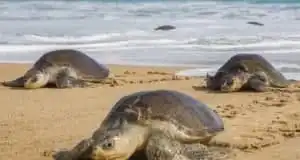
Sea turtles play a key role in marine and coastal ecosystems. However, these migratory species are threatened by the development of maritime economic activities and catches. In Togo, the HeildelbergCement Group is trying to protect them. In collaboration with CIMBENIN, the German cement manufacturer has made it a struggle, by initiating a cross-border Togo and Benin project in order to protect them. This project also targeted key feeding areas in order to assess sea turtle abundance and population trends.
Annual protection of key feeding and hibernating areas
Quantify the mortality rate associated with bycatch (including small-scale fishing), rates and intentional catches in key feeding locations and migration routes
Financed to the tune of 40,000 Euros, the coastal mammal protection project was implemented by the NGO AGBOZEGUE in Togo in the coastal part of the Mono transboundary biosphere reserve. The NGO was helped in its task by 4 ecoguards and 2 fisherman facilitators in the area from Agbodrafo to the Benin border, subdivided into 4 management sites.
The project involved monitoring sea turtle nesting sites, protecting nests until hatching, and training fishermen on best practices for handling sea turtles on board. Data collection is associated with all of these activities.
These activities made it possible to count the presence of several species of marine tortures: green turtle, leatherback turtle and olive turtle. This data comes from individuals caught ashore on beaches by local populations (shore captures), individuals caught at sea accidentally or intentionally by fishermen (sea capture), turtle individuals who died on beaches, spawns or nests (a nest represents a female who came to lay eggs on the beach), hatchlings that are caught on the beaches (they can be alive and released at sea or dead: hatching)), in addition, the hatchlings of a nest represent an individual, that is to say a female who is came to lay eggs), and the tracks (these are the tracks of females coming to lay eggs on the beaches).
During this mission, individuals caught accidentally in the nets were also recovered. These individuals were put back at sea. As for turtle nests when they are in danger, they are transplanted into incubation pens. The NGO AGBO-ZEGUE also recovers the shells of individuals who died on the beaches and keeps them at its headquarters.
Interviewed by Vert-Togo, Atsri Honam, an expert in ecological sciences and biodiversity conservation who worked on this project, tells us that the said project is one of the activities of the HeidelbergCement Togo Group that has acted positively on biodiversity.
“First of all, the approach itself has a positive impact on biodiversity. People have always used to keep turtle babies for several days after they hatch before releasing them into the sea. However, this does not have a positive effect on their survival at sea, even though it is estimated that around 1 in 1000 newborns survive and reach adulthood. Because turtle babies can swim at certain distances for about 72 hours from birth thanks to the reserves of their yolk sac, which is not completely absorbed at birth,” he explains.
Before continuing “therefore keeping baby turtles for more than 72 hours, makes them lose these abilities and can no longer practice their frenzied swimming in order to survive the hostilities of the sea. This increases their mortality rate. This is why, with the SCANTOGO project, arrangements are being made to allow baby turtles to return to the sea naturally.”
This project rescued approximately 950 baby sea turtles and 55 mature turtles from fishers' nets.
“We get them from the fishermen's hands and release them into the water. At the level of sea turtle nests, about 15 nests have been saved. In general, nests are not quickly located since sea turtles have this ability to hide their nests. They generally lay eggs at night. So it's not easy to identify the nests.”, he said.
“We therefore advised the Ecoguards with the NGO not to disturb the nests. Because this way of doing things affects the hatching rate of the eggs. We are taking all necessary measures to protect them. So it is a beach surveillance activity. There are people who are working. Around 15 Ecoguards are paid from the financing of SCANTOGO. Each Ecogarde receives 25 thousand FCFA per month.”, he says
And to specify: “It should be noted that we have subdivided the area because we operate from the Kpémé factory to the Togo-Benin border. So we subdivided this part of the beach into 4 zones. Each zone has a group of Ecoguards who watch over the nests. We collect information at regular intervals from the rangers and ensure that the eggs hatch. We follow the baby turtles until they return to the sea.”